|
|||||||||||||||||||||||||||||||||||||||||||||||||||||||||
|
|
|||||||||||||||||||||||||||||||||||||||||||||||||||||||||
 |
Chapter 30: BLOOD TRAILS"A PIECE OF JUNK." Dr. Henry Lee, world-renowned forensic scientist describing the microscope he was given to study crucial evidence.
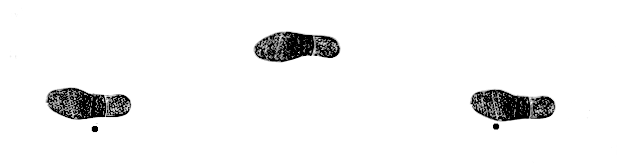
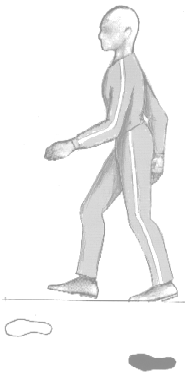
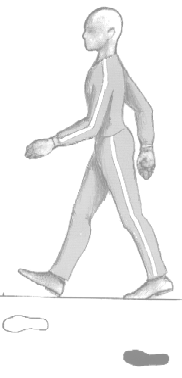
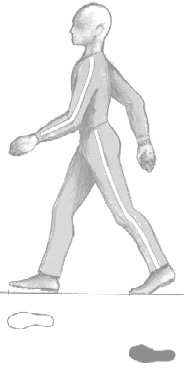
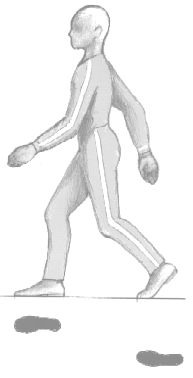
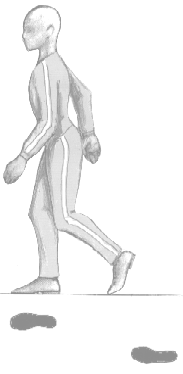
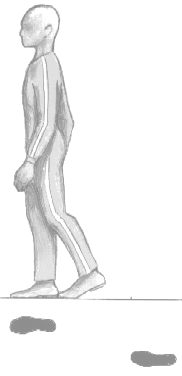
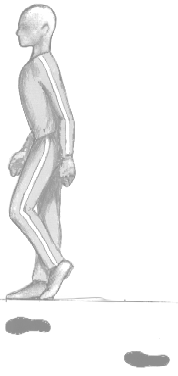
Which blood drop wold you expect to find beside the left shoe of a man over 6' tall taking a normal step with blood dripping from his left hand: A, B, or C?
Before trying to see whats wrong with the blood-drops to the left of the bloody Bruno Magli shoeprints, wed better check the validity of the question. Imprints identified by FBI agent William Bodziak as belonging to one of 299 pair of size 12 Bruno Magli shoes sold in the United States misstates the facts. The soles that left those imprints were made by a company called Silga, which keep spotty records of its shoe-making customers. The only connection we can make between the bloody shoeprints and the manufacturer is the possibility that it may have been Bruno Magli. By the same token, the shoes that left those prints may have been made by someone else and could look like anything above the soles.
The best way to see how walking speed is derived from shoeprints is by thinking of a silent movie or videotape on fast forward. With the speeded-up film, everyones steps seem not only brisk but also short and choppy. If you could change the length of the steps in the movies to match the speed of the film, youd get a believably smooth motion but unbelievably long strides. Where the film speed is slower, the strides seem longer and smoother. Thats because the real time relationship between how fast one steps and the space between them is fixed within a very narrow range. Try taking fast "baby steps" or slow "giant steps" and see what happens.
The size of the shoeprint and the height of the person who made it are also roughly proportionate. You are not going to find many men under 6 who can wear a size 12" shoe, or men over 6 who can slip into a pair of 9s. The size 12 Silgas would, therefore, be consistent with someone around O.J.s height. O.J. is 6 2". Mark Fuhrman is 6 3". Getting a blood-drop from a walking man to fall from the left hand at any angle next to the left shoeprint is tough to do by accident and virtually impossible to fake on short notice. The best you can do is stop, look and drop, which will give you a "C" pattern every time. So, now that we know how simple it is to tell whether or not a blood-drop came from a moving body and in what direction that body was moving, how come nobody got it right at Rockingham? How could the detectives and criminalists not have seen the direction in those drops? Why did the prosecution and the plaintiffs argue that O.J.s blood-drops on the Rockingham entrance of his drive were leading in when they were, in fact, going out? Looking at the prosecutions diagram of 360 North Rockingham next to the one that Fuhrman drew for his book, its apparent that either Fuhrman used the prosecutors diagram to make his or they used his to make theirs. In both drawings, the Bronco is scaled up so big and parked so close to the driveway that it could not have turned the corner of the drive onto Rockingham. The two closed gates along the south walkway between the garage and Katos bungalow are missing and the space shown between the garage and the curve of the driveway, where O.J. was supposed to have "hidden" a mysterious black bag behind his Bentley, does not exist. Neither does the obtuse angle formed by the exit of the drive and the street. Rosa Lopezs room on the south side of the fence just west of O.J.s garage is not shown. In short, the differences are 100% irrelevant and the significant additions, deletions and distortions are nearly identical. Either way, they both must have gotten the essential facts right in order to present them so precisely and so extremely wrong. One might conclude that a more distorted picture of the Rockingham crime scene could not have been drawn if the killer had done it himself, except that in this case, it looks as if that is exactly what happened.
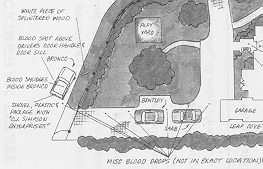
PROSECUTORS DIAGRAM FUHRMANS DIAGRAM When I say, distorted picture, you can see thats literally true. The diagrams are drawn so badly out of proportion and scale that specific locations of the blood-drops relative to the edges of the driveway cannot be indicated. The blood-drop photos taken on Marcia Clarks orders, after a conference with Fuhrman, are difficult to orient in space. Close-ups showing no direction are used to crop out familiar points of reference like O.J.s Bentley and the front door of his house. The Bentley itself was moved before the official crime scene photos were taken. Extreme camera angles also make it a chore to see landmarks where they are needed to gage spatial relationships. In other words, Marcia Clark planned those shots to hide rather than to highlight where the blood-drops on the driveway were deposited. Fuhrmans disclaimer that the blood-drops he indicated on his diagram running up the far left of the drive are not in their exact location only serves to make the unknown margin of error seem insignificant. But how can that be? Coming from Bundy, where Fuhrman had theorized that the killer was bleeding, as opposed to having allowed the victims blood to drip from the weapon he said they were cut with, the four detectives had to be looking for evidence of a bleeding killer. More than that, they had to be looking for signs that the killer was bleeding on the left side of his body. They had no bloody shoeprints to go by, but they had good landmarks in the precise location of the Bronco and the Bentley, and the sides of the driveway. Fuhrman, an avid hunter, was proficient at reading blood trailsplus, it was his theory! Lange and Vannatter's book, Evidence Dismissed, has a photo of the Rockingham entrance, minus the Bronco and the acute angle of the drive relative to the street. Only in that LAPD picture, out of all the photos showing blood-drops on the driveway, will you see O.J.s Bentley and Arnelles SAAB. Thats not where they were on the evening of June 12, so dont let that throw you the way it threw Allan Park who was shown the picture by Marcia Clark before his deposition. Its more than likely that the cars were moved on Fuhrmans orders when Vannatter left him in charge. In any event, the blood-drop locations shown in the picture should have told the lead detectives the same thing the wet transfer stain on bindle # 47 told Dr. Lee; namely, something was wrong.
If blood-drops did go directly to O.J.s driveway from a cut on his finger as he was walking, their lack of direction could have meant only one thing: They were altered before the pictures were taken by someone with the training, equipment and material to hide the truth. LAPD homicide detectives had such training and carried the same swabs, swatches, coin envelopes and eyedroppers with them in their official LAPD cars as the criminalists carried in their van. But, to say that O.J. was framed by Fuhrman, who could not have anticipated the celebritys cut finger, thats not enough. The killers "bleeding killer" theory had to have been an improvisation which required access to an official homicide detective vehicle after the fact. Since Fuhrman had no such car assigned to him that morning and he rode to Rockingham with three other detectives, he couldnt be sure of anonymous access to the necessary supplies. Therefore, his partner in the murder had to be another detective he could count on to participate in the investigation, someone who could pick up the car, drive it to Rockingham alone, and get to the blood-drops before the criminalists could. Did Fuhrman know anybody like that? Lets look at the candidates: In this exchange between Clark and Phillips, note how Phillips misled everyone with a one letter word describing Fuhrmans regular partner, Brad Roberts. Note the awkwardness of his testimony about the four dead end calls that followed his contact with Roberts. Note the impression he leaves throughout the trial that Roberts was partnered with someone else.
Q: AND WHAT DID YOU DO AFTER THAT? A: I THEN ALSO NOTIFIEDI BELIEVE I MIGHT HAVE DONE THIS ON MY CELLULAR PHONE ENROUTE TO THE STATIONI ALSO NOTIFIED TOM NOLAN WHO IS A WEST L.A. HOMICIDE DETECTIVE. I BELIEVE I NOTIFIED TOM NOLAN AFTER I MADE THREE OTHER ATTEMPTS TO NOTIFY THREE OTHER DETECTIVES WHO WERE NOT AVAILABLE, AND THEN I NOTIFIED TOM NOLAN AND HE SAID HE WOULD MEET DETECTIVE ROBERTS EITHER AT THE STATION OR AT THE SCENE, DEPENDING ON WHAT TIME THEY GOT IN THERE TOGETHER. Nolan never teamed up with Roberts. Since Phillips involvement was strictly as a facilitator, Fuhrman and Roberts were the only working detectives on the case for over an hour and a half. Roberts was, in fact, Fuhrmans partner all along, and would never have been partnered with Nolan if Fuhrman had anything to say about it, which he did. Isnt there something fishy about all of that, in a case where the only way the accused could be innocent is if he was framed by Mark Fuhrman and another detective? If Fuhrman wasnt on call, neither was Roberts. If four other detectives (they worked in pairs) were on call, why was Fuhrman called first? Why were the next three detectives that Phillips called after Roberts unavailable, and the fourth called so late that he was not likely to have ever gotten involved in a high profile case? Without Roberts, there could have been no blood trail from Bundy to Rockingham, because he was the only one who could have manufactured it. Perhaps youve noticed how peculiarly and unprofessionally key people in this case behaved after talking to Fuhrman. It happened to Phillips, Vannatter, Lange, Clark, Hodgman, and, possibly, Yamauchi and Kestler, who showed all the symptoms of early exposure to the old Fuhrman charm. Fuhrman was their prime source of critical evidence, a fountain of ideas about how it should be interpreted, and a Pied Piper to experts on how to proceed with the investigation. Phillips was first to get in line. You can draw a logical connection between Phillips and Fuhrman, because they were friends and Phillips knew how smart and ambitious he was. With Fuhrman comes Roberts, because they were partners. But how could four other detectives on call for that night have been "unavailable" without a specific request from Fuhrman to artfully exclude them? No record exists of anyone riding in the same car with Roberts, so no one can say what was or was not missing from it or carried in it to or from Rockingham. Roberts has a deeper, "older-sounding" voice than Fuhrmans. It matches the description of one angry voice heard by Robert Heidstra at Bundy during the killings. Heidstra never got to hear Roberts voice in an excited state the way he heard O.J.s before he was called to the stand. Roberts was never called to the stand. He filed no official reports. However, according to Mark Fuhrman, he was "marking" the Rockingham blood-drops before Dennis Fung stopped him. Fuhrman wrote about the incident in his book to explain away the blood-drops he pointed to in his drawing that did not appear in the photos. In case Fung was asked about Roberts actions in regard to the blood-drops on O.J.s driveway, it would also explain what he was doing with them. Roberts is the detective who told O.J. when he was handcuffed at Rockingham on the 13th that a blood trail ran from Nicoles body to his house. He was close enough to the drops to know which direction they were going in. Its more likely that he was "collecting" blood samples than merely marking them before they were photographed. Since it was "obvious" to all which direction they must have been going in and detectives were authorized to take blood samples, it would not have been an issue at that time for anyone but Dennis Fung. Had he gotten close enough to the tiny droplets to notice the direction before Roberts obscured them, a simple admission of error would have sufficed.
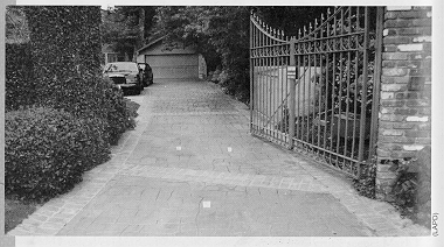
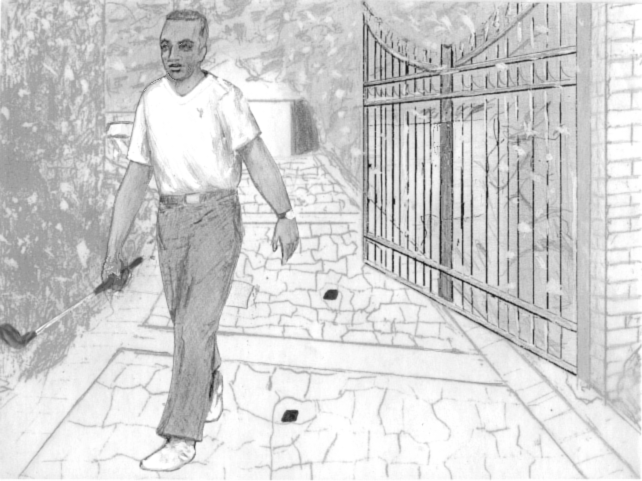
In our picture of O.J. walking through the gate with the golf club in his hand, you will notice that only 2 of the 3 spots where the blood-drops were marked are shown. Thats because the first 2 tiny droplets were probably slung forward at the same time with one swing of the arm. O.J. said that his dog ran through the gate as soon as he opened it and across the street. He might have raised his arm in sudden fear that the dog might be hit by a car. It might also have come from the natural swinging of his arm. Either way, the gate was open and he was on his way out. As you will see, the third droplet was deposited later. Scale the width of a man to the width of the gateway in the photo, as I did, and try to duplicate the triangular blood-drop pattern. You cant get all 3 drops in one pass or connect any 2 of them with the man going into the property bleeding from the left side. But as soon as you see where O.J. had to be standing before he exited the gate if he opened it manually, the mystery of the three drops goes away. The key here is the fact that O.J. truly did not know when or how he was cut, as evidenced in the civil trial when he could have cleared himself with any simple story that matched the blood-drops on his driveway. The story he did tell had to be dragged out of him by Dan Petrocelli, who obviously understood the implications of the odd blood-drop pattern: Q: When you went out towards the Rockingham gate, how did you cause the gate to open? A: Push a button. Q: Right on the inside of the gate? A: Yes. Q: Which side? A: Left side. Q: And the gate swings inward? A: Yes. Q: And then you go out the left side, right [This is the most important question asked in the civil trial. If O.J. or his attorneys had understood the significance of it, the trial would have ended in O.J.s favor and given the LAPD a whole lot of explaining to do.]. A: I dont know. Left side or the right side [The blood-drops say he did both]. Q: The box is on the left side of the gate, the gate starts to open and then you exit. Correct? A: Correct [as you will see from the pictures of the gate in both positions, thats true]. Q: And you walked to your car? A: Yes Q: The Bronco? A: Uh-huh. The more Petrocelli grilled him about where he went and what he did during the time of the murders, the more he filled in the details needed to explain the blood on his drivewayunwittingly. O.J. never realized what a problem his real blood trail would have been for the plaintiffs if anyone had given them a good look in context. One thing for sure, the gate had to be open for him to leave the three drops characterized by the four detectives as going into the compound. How that gate opened, which way it swung and how long it stayed open, made all the difference in the world as to whether or not a reasonable case could be made for a bleeding man in a big hurry going in. O.J., believing that he had cut himself when he was rushing around on the tail end of his trip rather than when he was goofing off earlier, never connected the dots. His defense team in both trials, seeing no direction in the drops, concluded that some of them were planted rather than obscured and tried to minimize their significance. Big mistake. They were like windows in time that told the same story O.J. did. Oh yeah, about the gate. It opens slowly, stays open 30 to 40 seconds, then closes... Q: Did you go to the Bronco after you completed all of the activities described at the Bentley [The activities O.J. described at the Bentley were, getting his golf balls and his pitching wedge. Getting was the word hed used.]? A: Yes, sir. Q: You had finished hitting all your golf balls. Right? A: Yes, sir [did O.J. hear, hitting or getting? Probably, getting, since thats what hed just told the man, and he did not hedge or hesitate about when he started hitting the balls when the question came up again.]. Q: And you had closed the trunk of the Bentley, right? A: Yes. Q: So on the ground was the bag with the windbreaker? A: Yes, I believe so, yes. Q: OK. So before you went inside you went to the Bronco? A: Yes, I believe so, yes... ...Q: After you made the phone call, you either put the phone down or in your pocket? A: Uh-huh. Q: If you put it down where did you put it? A: Right in the trunk of the Bentley. Q: And you opened up the trunk and you described what you did at that point?" A: Yeah. Q: Closed the trunk? A: Yes. Q: Took your 3 wood out of the Bronco. A: Yes. Q: And you were looking for your sand wedge? A: Yes. Q: And you didnt find it, right? A: Correct. Q: And you waited for the dog to finish and then A: We walked up the street. She went across and up a way. First she went to Stanley Sheinbams stuff, and she walked up. Started going up the grass to the other, and I was just on the grass walking, swinging, and then finally, "Come on, Chachi," and we went into the Ashford gate. Q: The Rockingham gate closed behind you? A: Yes. Q: And then you entered the Ashford gate [O.J. could not have been thinking about the blood trail that confirmed his story, because he didnt know it existed then. You can bet that Petrocelli knew. You can bet thats what the question was designed to find out about O.J.]? A: Yes. To explain the blood-drop on the left side of the short walk leading to his front door, he could have said that he went into the front door. The blood trail going from the Rockingham gate around the block to Ashford, would have made perfect sense and given O.J. a perfect alibi. There was nothing in his previous testimony or statements to police that would have prevented it. He had plenty of time to do it and millions of dollars worth of incentive to think it over. Yet, he said that he went in the gate with the dog, he skipped the chipping, and told of putting his 3 wood in the garage and entering his kitchen through the garage. Why? Because he didnt know precisely were the blood-drops were found. Perhaps he didnt want to know. Perhaps they were washed away before he could see them. Whatever the case, he wasnt likely to have been able to tell by the available photos. All of which adds up to one thing; O.J. truly didnt know when or how he was cut, but a close observer would have been able to take an educated guess.
In light of what can be readily discerned with an accurate layout of the Rockingham crime scene, it appears that Dr. Lee was handicapped in his ability to reconstruct what happened there for a reason. I cant say what that reason was, but the effect was to bury the fact that the blood on the driveway could not have been a continuation of the Bundy blood trail. If there was a link between blood trails at Rockingham and Bundy, it would have to have started at Rockingham. The whole picture painted by the Rockingham blood trail would have given the prosecution a problem with Fuhrman that went way beyond allegations of racism and evidence manipulation. Why else would Marcia Clark ask Fuhrman what his alibi was for the evening of the 12th? Why else would Dr. Lee be given junk equipment, bad photos and permitted only 20 minutes at each crime scene? I dont think that anyone has even tried to formulate a reasonable answer to that one. Dr. Lees ability to read a crime scene was unsurpassed. Only because of my experience as a design modeler building good 3-D models from bad 2-D sketches and blueprints, was I able to identify relevant features in the prosecutions photos and diagram and put them closer to where they belonged. I have to confess that this book would have been in print months earlier if I, too, hadnt been fooled. I copied a distortion in the Clark/ Fuhrman diagram, that turned strong evidence of innocence on its head. Dr. Lee would, no doubt, have seen what the prosecution did and what you are about to. He would have seen that O.J.s trail of blood at Rockingham proved his innocence, and Fuhrmans "brilliant deduction" or "lucky guess" about a dog bite had nothing to do with brilliance or luck, and everything to do with an observer.
|
||||||||||||||||||||||||||||||||||||||||||||||||||||||||
 for Adobe
PDF version of Chapters 31-35 for Adobe
PDF version of Chapters 31-35Contact the author: Jasper Garrison 
Send comments/suggestions |
|||||||||||||||||||||||||||||||||||||||||||||||||||||||||


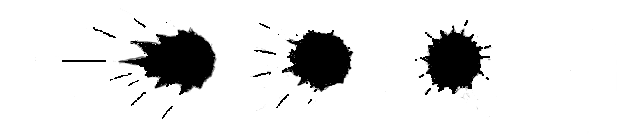
 As to
the likelihood of the Bundy blood-drops being left by a six-footer taking a normal
30" stride, youd be safest with A or Bthough it would be like throwing a
strike blindfolded over a moving plate that isnt there yet. Something like C might
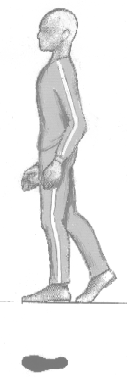
be found more or less in line with the right shoeprint if the drop fell from the
cut on the extreme back swing of the hand just before it started forward. The effect comes
not only from the motion of the body, but the motion of the arms swinging in
counter-balance to the legs. Watch the position of the left hand relative to
the left foot of our walking man in mid stride. Remember that the maximum point of
acceleration in the forward arm swing is here, sweeping past 6 oclock in less than
one-twelfth of a second. Only a stationary hand in that position would leave a circular
drop, though it might take a microscope to see the difference. Sample swatch # 47, taken
from the circular drop next to the Silga shoeprint, was supposed to be from O.J.s
blood. Its the sample Andrea Mazzola packaged and initialedthe one that went
into the wrapper dry and came out uninitialed with telltale signs that it had gone in wet.
Its the one Henry Lee was talking about when he said the only conclusion he could
draw was, "something wrong."
As to
the likelihood of the Bundy blood-drops being left by a six-footer taking a normal
30" stride, youd be safest with A or Bthough it would be like throwing a
strike blindfolded over a moving plate that isnt there yet. Something like C might
be found more or less in line with the right shoeprint if the drop fell from the
cut on the extreme back swing of the hand just before it started forward. The effect comes
not only from the motion of the body, but the motion of the arms swinging in
counter-balance to the legs. Watch the position of the left hand relative to
the left foot of our walking man in mid stride. Remember that the maximum point of
acceleration in the forward arm swing is here, sweeping past 6 oclock in less than
one-twelfth of a second. Only a stationary hand in that position would leave a circular
drop, though it might take a microscope to see the difference. Sample swatch # 47, taken
from the circular drop next to the Silga shoeprint, was supposed to be from O.J.s
blood. Its the sample Andrea Mazzola packaged and initialedthe one that went
into the wrapper dry and came out uninitialed with telltale signs that it had gone in wet.
Its the one Henry Lee was talking about when he said the only conclusion he could
draw was, "something wrong."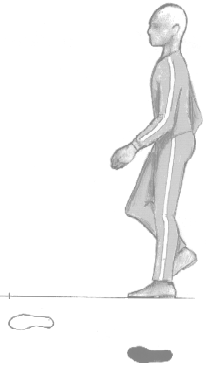
 The question
of direction did not play a part in Lange and Vannatters thinking about the blood
trail. It was enough for them that they saw blood on the driveway. Never mind, precisely,
where it was or what that precision could tell them about Fuhrmans bleeding killer
theory. They had already accepted it.
The question
of direction did not play a part in Lange and Vannatters thinking about the blood
trail. It was enough for them that they saw blood on the driveway. Never mind, precisely,
where it was or what that precision could tell them about Fuhrmans bleeding killer
theory. They had already accepted it. 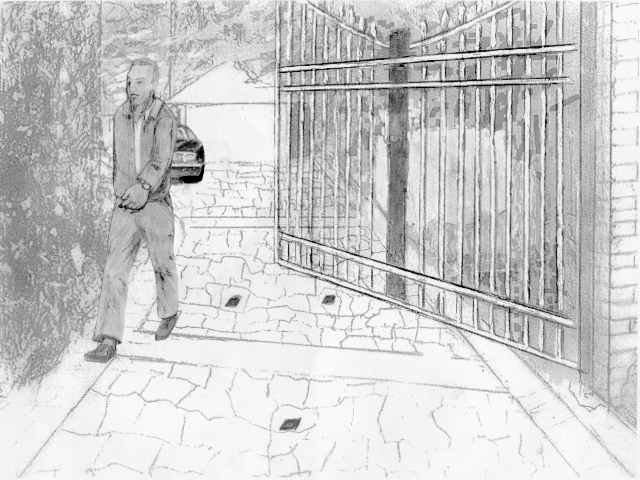 Lange
and Vannatter, who could have connected the dots on the day they interviewed O.J., were on
a different mission. Playing a covertly aggressive game of "good cop/good cop"
with O.J., they sought only to catch him in a lie. They interpreted everything possible as
an inconsistency, including a statement he made at one point that he was doing things in a
leisurely way and at another point he said he was rushing. Had Henry Lee been given
adequate time and resources to do his job the way he wanted to, he would have seen by the
placement of those drops that O.J. had taken a leisurely walk through the Rockingham gate
at one pointand a hurried one later on.
Lange
and Vannatter, who could have connected the dots on the day they interviewed O.J., were on
a different mission. Playing a covertly aggressive game of "good cop/good cop"
with O.J., they sought only to catch him in a lie. They interpreted everything possible as
an inconsistency, including a statement he made at one point that he was doing things in a
leisurely way and at another point he said he was rushing. Had Henry Lee been given
adequate time and resources to do his job the way he wanted to, he would have seen by the
placement of those drops that O.J. had taken a leisurely walk through the Rockingham gate
at one pointand a hurried one later on.