Chapter 29
Staying in Character
When I was
compiling my list of recurring names, props and themes I linked to Fuhrman in the movies I
hit a snag. There were so many of them one could argue that there were bound to be
illusory connections between some of them and Fuhrman purely by chance. I understood the
argument because that was my first impression. In the novel I wrote two years before the
murders, I used some of the names, objects and themes you see in Fuhrmans account of
his O.J. Simpson murder investigation. I even have a Jimmy and a Cain in the same
character.
My novel
had nothing to do with the murders in Brentwood. It stood to reason that the similarities
I noticed between the movies and the murders had nothing to do with each other
except for three things:
1.
I had no ambition to write a screenplay.
2.
I did not contribute to the evidence against
O.J. Simpson.
3.
I was not obsessed with the movies or the
Simpsons.
Prior to
June 13, 1994 O.J. Simpson  was to me a living football legend, a football color commentator and a
celebrity who did commercials for Hertz Rent-a-Car. He was an actor who wasnt much
of an actor except for one serious role in Roots and his hilarious role as Nordberg
in The Naked Gun series, a role that no man who took himself seriously could play.
O.J. was a constant TV presence. I saw him on Dragnet, on a Lucile Ball show
and the television move Detour to Terror. O.J. was a household name. White women
openly lusted for him and white men genuinely liked him. Everyone placed him above race.
That was my picture of O.J. Simpson. was to me a living football legend, a football color commentator and a
celebrity who did commercials for Hertz Rent-a-Car. He was an actor who wasnt much
of an actor except for one serious role in Roots and his hilarious role as Nordberg
in The Naked Gun series, a role that no man who took himself seriously could play.
O.J. was a constant TV presence. I saw him on Dragnet, on a Lucile Ball show
and the television move Detour to Terror. O.J. was a household name. White women
openly lusted for him and white men genuinely liked him. Everyone placed him above race.
That was my picture of O.J. Simpson.
I was
almost finished with my second book in The Random Factor trilogy and getting The
Invisible Warriors ready for the printer when I heard the news about the murders in
Brentwood on my car radio. I heard that someone had repeatedly slashed and stabbed O.J.s
wife and a younger, unidentified white man with a knife.
The story
included reminders that O.J. had a record of wife beating, that his wife was 12 years
younger than he was and she was white. The gratuitous racial references were enough to
make it clear that O.J. was no longer above race. All of the elements were present from
the start to draw only one reasonable conclusion: The black 46-year-old celebrity obviously
killed his white 35-year-old wife and a white 25-year-old man in a jealous rage. The
similarities between that story and a shallow reading of Shakespeares Othello
had to be coincidental. It was the same story, minus Iago, with a few things moved around
a bit. Everybody understands coincidence about as well as they understand
Shakespeare.
As more
news  about the
murders in Brentwood came in I learned that the first report was a tad off. The murdered
woman was O.J.s ex-wife, not his wife. According to these reports he took an
unscheduled flight to Chicago on the night of the murders but and alibi was questionable.
Los Angeles police found a bloody glove on the murder scene and a matching
glove on his Rockingham estate. They found a blood trial leading from O.J.s
car into his driveway and a bloody ski mask in his bedroom closet. The murder weapon wasnt
a knife, as first believed. It was a military entrenching tool, a compact digging
instrument with a folding spade like James Woods uses in Best Seller with
Brian Dennehy to dig up a murder weapon. Chicago police found one covered
with blood in a dumpster near O.J.s hotel. about the
murders in Brentwood came in I learned that the first report was a tad off. The murdered
woman was O.J.s ex-wife, not his wife. According to these reports he took an
unscheduled flight to Chicago on the night of the murders but and alibi was questionable.
Los Angeles police found a bloody glove on the murder scene and a matching
glove on his Rockingham estate. They found a blood trial leading from O.J.s
car into his driveway and a bloody ski mask in his bedroom closet. The murder weapon wasnt
a knife, as first believed. It was a military entrenching tool, a compact digging
instrument with a folding spade like James Woods uses in Best Seller with
Brian Dennehy to dig up a murder weapon. Chicago police found one covered
with blood in a dumpster near O.J.s hotel.
How could
any reasonable person not presume that O.J. was guilty?
I would
have had no doubt of O.J.s guilt if he had confessed, if the only story about his
cut finger from witnesses on his plane didnt back up his story and if the news
stories about other evidence didnt keep changing. The murder weapon was a knife
after all, not an entrenching tool. O.J.s flight to Chicago was scheduled weeks in
advance. Reporters were either doing a sloppy job of gathering information or somebody
with inside knowledge was deliberately feeding them false reports.
First
reports in big, ongoing news stories are notoriously inaccurate. Ordinarily you can rely
on them only as rough sketches. They are usually followed by error corrections and more
details in subsequent reports to give you a more accurate picture. The difference here was
that the errors kept piling up. Every day that the media corrected one error they added
one or two new errors. When they had to choose between getting the new story out right and
getting it out right away they invariably chose to get it out right away. Soon, they
stopped correcting small errors altogether and relied more and more on
confidential sources close to the accused, the female victim or the investigation. Those
errors persist.
In the
first six months after the murders it became difficult to tell the mainstream media and
the tabloid media apart. They all reported anything that painted O.J. a darker shade of
guilt and a darker shade of Negro. Time magazine went so far as to feature a mug
shot of O.J. on its cover altered to make his skin color darker than it was.
And what
was the deal with the cop who found the bloody glove on Rockingham? Who was calling him a
racist? Where was the evidence that he was? Assuming he was a racist and racism motivated
him to plant the Rockingham glove, where did he get it? What about all of the other
evidence that other police officers found, like the blood smeared all over his Bronco door
handle and the blood trail from Bundy going into O.J.s Rockingham gate? What about
the stories of other spouse-abuse incidents we hadnt heard before; Nicoles
desperate call to 911 and this thing about O.J. threatening Nicole with a baseball bat?
Surely one man
couldnt b e at the bottom of
all those things. Besides, every alternative to O.J.s guilt looked too much like
what Iago did to bring down the title character in Shakespeares Othello and
the bad guys in my first novel did to one of my characters to be real. They
looked too much like frame-ups in Dick Tracy, Strangers on a Train, The Dark
Corner, To Protect and Serve, Ricochet,
Physical
Evidence, Mr. Destiny, The Last Innocent Man, China Moon, and The Naked
Gun. e at the bottom of
all those things. Besides, every alternative to O.J.s guilt looked too much like
what Iago did to bring down the title character in Shakespeares Othello and
the bad guys in my first novel did to one of my characters to be real. They
looked too much like frame-ups in Dick Tracy, Strangers on a Train, The Dark
Corner, To Protect and Serve, Ricochet,
Physical
Evidence, Mr. Destiny, The Last Innocent Man, China Moon, and The Naked
Gun.
They looked too much
like popular fiction.
The bad guys I invented for The
Random Factor would have known whether O.J. was guilty or innocence because they
possesses a technology that allows them to see and record past events. I was already
running into problems with my vision of 21st century inventions that were
coming into common use thirty years earlier than I anticipated. Writers take that risk
whenever they use advanced technology of their day and project what it will become in the
near future. The murders that O.J. Simpson appeared to be guilty of committing presented
the same problem and required the same method of solving it.
I had to go back to my novel and
modify it to take into account every new development that would be old news at
some unspecified point between 2130 and 2150. I couldnt tell when a new development
in the O.J. Simpson case would give a definitive answer to whether or not O.J. did it.
Thats how I came to learn that he didnt and Mark Fuhrman did.
WARNING: The following paragraphs are rated R for adult language
and unmistakable symbolism for a specific sexual act....
Creating a  world is hard. The laws of physics, probability
and human nature dont change but everything and everybody in the world you create
affect everything and everybody around them. If you dont work within those
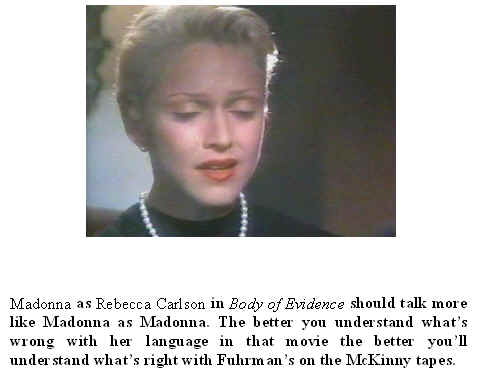
limitations it shows. And it sucks. When you hear Rebecca Carlson in Body of
Evidence say, Have you ever seen animals making love? youll get
the point. Really now, has anyone ever seen animals making love. More
importantly, she says this to William DeFoe as her married lawyer Frank Dulaney
in an R-rated movie as he is driving her home in the rain. Would Madonnas
character use that language in that situation? No fucking way. world is hard. The laws of physics, probability
and human nature dont change but everything and everybody in the world you create
affect everything and everybody around them. If you dont work within those
limitations it shows. And it sucks. When you hear Rebecca Carlson in Body of
Evidence say, Have you ever seen animals making love? youll get
the point. Really now, has anyone ever seen animals making love. More
importantly, she says this to William DeFoe as her married lawyer Frank Dulaney
in an R-rated movie as he is driving her home in the rain. Would Madonnas
character use that language in that situation? No fucking way.
Why would a sexually adventurous adult who flaunts her sexuality in
public talk that way to another adult in private? Perhaps the writers did what I did in The
Random Factor, using her language is a clue to some hidden component of her
personality, her innocence, her guilt, her motives or her MO that accounts for this
inconsistency? They didnt. They simply failed to match the language to the
character.
The Body of Evidence producers unabashedly patterned Madonnas
Rebecca after Sharon Stones Catherine in Basic Instinct. The sexual shocker
there was in the interrogation room where you can see Stones pubic hair when she
crosses her legs. Her character then takes a polygraph test, passes it and boasts to the
detective driving her home in the rain that she could have beaten the test if she were
guilty. In Body of Evidence the sexual shocker is supposed to be Madonna
putting her middle finger in her panties and simulating masturbation. The real shocker is
what she does with that finger before then. She buries it past the second knuckle in her
mouth.
In a restaurant scene she puts a strawberry in her mouth to convey
the same message. In Madonnas Truth or Dare documentary, a friend asks her to
demonstrate with a longneck bottle how she gives head. She does like someone who
has had a lot of practice like Faye Resnicks portrait of Nicole Simpson. She
even swallows the water in the bottle.
Madonnas Body of Evidence use  of her finger and the
strawberry are French connections to the character and to the actress, a combination of
fiction and fact. Its also a French connection to Witness for the Procution
(the murder victims name), to Murder in Greenwich (the movie that Banks uses
as an alibi) and the McKinny tapes. Fuhrman uses the word cocksucker at the
start of the first tape in a way that implies he had been using it regularly before she
started recording. The character he says he was play acting on the tapes
sounded so much like The French Connections Popeye Doyle that I was sure he
mentioned him and the movie by name in Murder in Brentwood. He didnt. of her finger and the
strawberry are French connections to the character and to the actress, a combination of
fiction and fact. Its also a French connection to Witness for the Procution
(the murder victims name), to Murder in Greenwich (the movie that Banks uses
as an alibi) and the McKinny tapes. Fuhrman uses the word cocksucker at the
start of the first tape in a way that implies he had been using it regularly before she
started recording. The character he says he was play acting on the tapes
sounded so much like The French Connections Popeye Doyle that I was sure he
mentioned him and the movie by name in Murder in Brentwood. He didnt.
I didnt know there was a French connection in Murder in
Greenwich when I wrote about it in The Smoking Gun and I didnt pick it up
it by way of chance or psychic intuition. I got it from the arrangement of little things
Furman says in Murder in Brentwood before and after he describes his Dirty
Harry meets Attila the Hun character. Once he got started down a certain track he
couldnt switch over to another one.
This is what novelists mean when they say characters begin to talk
to them. Fictional characters in some situations have a wide range of options. In other
situations they are locked into the demands of their personalities, their roles, their
habits, their desires, their fears and their surroundings. They say what they say and they
do what they do because they have no choice. I incorporated this revelation into my Random
Factor plot because once I discovered it I had no choice. If I tried to force
something into the situation that didnt belong, it showed.
Thats one of many reasons that movies like Body of
Evidence hit so many false notes and no amount of gratuitous sex or nudity can save
them. Thats also why gratuitous sex, nudity, violence and foul language dont
work. The principle is the same. Either they fit or they dont.
Mark Twains Huckleberry
Finn  doesnt work without the n-word.
No other word will do. When you see Frederic Forrest in The Conversation with Gene
Hackman and Cindy Williams remember that Forrest is Pap in The Adventures of
Huckleberry Finn (85). Mark Twains Pap uses the n-word because his
character wouldnt know what other word to use. Rap star Ice-T who appears with
Christopher Meloni in Law and Order: Special Victims Unit uses the word repeatedly
in his Ricochet rap. Denzel Washingtons character Nick uses the word
only when talking to Ice-T as Odessa because he is speaking Odessas
language. doesnt work without the n-word.
No other word will do. When you see Frederic Forrest in The Conversation with Gene
Hackman and Cindy Williams remember that Forrest is Pap in The Adventures of
Huckleberry Finn (85). Mark Twains Pap uses the n-word because his
character wouldnt know what other word to use. Rap star Ice-T who appears with
Christopher Meloni in Law and Order: Special Victims Unit uses the word repeatedly
in his Ricochet rap. Denzel Washingtons character Nick uses the word
only when talking to Ice-T as Odessa because he is speaking Odessas
language.
Erotic thrillers like Fatal
Attraction, Body Heat and Basic Instinct require the same level of consistency.
Can you imagine Catherine Tramell saying, I liked making love with him, as
opposed to using the f-word or Alex Forrest calling Dan Gallagher a dirty rat
as opposed to a cocksucker? There, I said it again. I used the cs-word. Nobody
would have known what I was talking about or why it mattered if I hadnt.
It matters because Fuhrman used that word on the McKinny tapes. It
matters because of O.J.s angry words to Nicole on the October 1993 911 tape about
seeing her through a window with restaurant manager Keith Zlomsowitch. It matters because
that tape was released by the city attorneys office where Fuhrman had a friend in a
position to release it. It matters because that tape sets the stage for Fuhrmans
attribution of O.J.s motive for murder and because Fuhrman boasted of having sex
with Nicole before she made the call, her only confirmed 911 call. It matters because of
Fuhrmans role in Bill Clintons impeachment.
When Fuhrman uses nigger
and cocksucker on the McKinny tapes they flow naturally from his lips. Whether
he is talking about something that happened or something he made up, his character
and the characters he talks about are consistent. They say and do things that people with
the qualities he attributes to them have to say and do to stay in character. His character
cant tell Laura Hart that Judge Itos wife Peggy York used sex to
advance her LAPD carrier. He has to say she fucked and sucked her way to the top.
Thats how this character on the McKinny tapes thinks. His language is
what shapes his character and opens the door to his mind.
When Fuhrman describes wallowing in
the blood of people he says he assaulted and enjoying the smell of niggers who
were killed in a building about to be razed his voice drips with pleasure. He sounds like
a combat soldier soaking up the unique sensory conformation of his superiority in a
firefight. You cant get that feeling from standing around bloody crime scenes. You
cant get it from drinking buddies or the movies because the immediacy of mortal
danger, the feeling of power and the sense of smell are so much a part of it. You cant
know how good it feels to kill an enemy soldier in combat unless you do it. I ran
into many combat veterans who felt the same way and all of us were reluctant to
delve into it the way Fuhrman does.
Heres the rub: Mark Fuhrman was
never in combat.
The issue here is consistency of character. Fuhrmans
abrasive, arrogant, racist, profane, violent character on the McKinny tapes is consistent
with the man he presented himself to be to at least eight people. These people were spread
out over several years and miles of geography and they didnt know each other. Yet,
they describe the same character.
Fuhrmans stories have a consistent flow when he inserts this
character. When he doesnt, they sound like composites of scenes from various movies
made for commercial TV. He does the later in Murder in Greenwich.
You see it best when his character goes to Steve Carrolls house to seek his
help in getting Marthas killer and humbles himself in the process. The camera sweeps
past a Jack O Lantern on the porch. Fuhrman
knocks on the door. He is wearing his brown leather jacket. A dog barks. Carroll comes to
the door in a sweater and the two men talk about Martha Moxley through the screen. He
promises to catch Marthas killer. He is no longer a homicide detective officially
but hes still a cop in his heart. a consistent flow when he inserts this
character. When he doesnt, they sound like composites of scenes from various movies
made for commercial TV. He does the later in Murder in Greenwich.
You see it best when his character goes to Steve Carrolls house to seek his
help in getting Marthas killer and humbles himself in the process. The camera sweeps
past a Jack O Lantern on the porch. Fuhrman
knocks on the door. He is wearing his brown leather jacket. A dog barks. Carroll comes to
the door in a sweater and the two men talk about Martha Moxley through the screen. He
promises to catch Marthas killer. He is no longer a homicide detective officially
but hes still a cop in his heart.
This sequence comes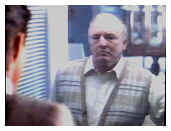 straight out of Murderous Vision
where Bruce Boxleitner as Det. Robeshaw knocks on a door wearing a brown
sports jacket. A dog barks. Marthas father comes to the door in a
sweater-vest. The men speak to each other through the screen. Robeshaw humbles himself. He
is no longer a homicide detective but he is still a cop. He promises to do everything he
can to catch Marthas killer. In a psychic vision, Murderous Visions Elizabeth
wouldnt be able to tell the Fuhrman/Carroll screen door scene and the
Robeshaw/father screen door scene apart. They look like pieces of the same dream. straight out of Murderous Vision
where Bruce Boxleitner as Det. Robeshaw knocks on a door wearing a brown
sports jacket. A dog barks. Marthas father comes to the door in a
sweater-vest. The men speak to each other through the screen. Robeshaw humbles himself. He
is no longer a homicide detective but he is still a cop. He promises to do everything he
can to catch Marthas killer. In a psychic vision, Murderous Visions Elizabeth
wouldnt be able to tell the Fuhrman/Carroll screen door scene and the
Robeshaw/father screen door scene apart. They look like pieces of the same dream.
In Pieces of Dreams with
Lauren Hutton (Jessica in Fear) Robert Forster is a Catholic priest a
father. He appears as Jake in American Perfekt with Fairuza Balk as Alice.
Boxleitner is a CIA agent codenamed Scarecrow in The Scarecrow and Mrs.
King. Fairuza Balk as Dorothy returns to
the Land of Oz on Halloween. With the help of Jack, a new friend with a Jack O
Lantern head, she frees her old friend the Scarecrow held prisoner by the Gnome King.
Christopher Meloni is Fuhrman in Murder in Greenwich. He is a prisoner in Oz.
When Fuhrman wrote his letter to the
city attorney in 1989 he hadnt yet gotten the hang of how to write dialogue and
actions for real people. In his letter, he has one of the most recognized people on the
planet telling him his name (Im O.J. Simpson!). The name with the
exclamation point is supposed to signify a man so arrogant that he expects the mention of
it to open doors of privilege reserved for a Medieval prince. However a man that arrogant and that well known
would assume that everybody knew who he was. His would expect his physical presence to
tell all who gaze upon him his name. Fuhrman could have had a supremely arrogant O.J.
referring to himself in the third person but even then he would not call himself O.J.
Simpson. He would call himself O.J.
Fuhrmans account of what he
witnessed O.J. saying and doing cant be true. He has O.J. in an agitated but
controlled state while everything he says ends with an exclamation point. He has O.J.
saying things that only a pimp would say about his whore. He has Nicole doing something
that nobody could do. But you get the full story only when Fuhrman explains why he
couldnt identify her body on the murder scene. In his letter he says that she was
sobbing. Explaining why he couldnt identify her body he says that when he saw her
with O.J. she was crying with her face in her hands. Even when she is talking to him and
pointing in fear at O.J.?
You might put something like this in
a first draft of a fiction story and winch in embarrassment when you go back to it a few
days later. Fuhrman never looked back at the logic of his characters words and
actions in the letter or the logical consequences of his revision. He didnt have to.
Everyone he required to buy it bought it. None of them knew he was working on a screenplay
and that he aspired to become a celebrity author like Joseph Wambaugh. None of them knew
how the O.J. character he created in his letter would evolve into the real O.J. Simpson on
trial for killing Nicole Simpson and Ron Goldman in a jealous rage.
Are we looking at a psychic who saw
the future? No. We are looking at a sociopath who created the future with proven formulas
for success. We are looking at values of x in a double homicide and the murder trial of
O.J. Simpson. Values of x in this formula are in the movies. They come from Fuhrmans
reliance on them to achieve his ambitions by murdering two people, framing O.J., starting
rumors, telling lies, getting other people to lie for him, and writing a formula
bestseller.
The value 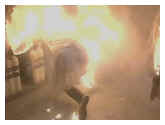 of x in any move linked to
Fuhrman is the persona, setting, props or theme that surrounds it. In any movie with
Denzel Washington, for example, the value of x is implicit because of his portrayal of the
title character in Spike Lees Malcolm X. The value of x in Swamp Thing (81) is the notebook of formulas missing from Alec Hollands experiments. This notebook holds the last secret of
grafting animal DNA onto plant DNA to create a super plant. Alice Cable hides
it under her body when Alec, gets set on fire in his lab, a lab with a greenhouse. You
will recall Fuhrman standing over a charcoal grill saying, That one is burning,
just before he learns that Alex Grafton has the value of x in the blanked out Moxley
files, then visiting Grafton in his greenhouse. of x in any move linked to
Fuhrman is the persona, setting, props or theme that surrounds it. In any movie with
Denzel Washington, for example, the value of x is implicit because of his portrayal of the
title character in Spike Lees Malcolm X. The value of x in Swamp Thing (81) is the notebook of formulas missing from Alec Hollands experiments. This notebook holds the last secret of
grafting animal DNA onto plant DNA to create a super plant. Alice Cable hides
it under her body when Alec, gets set on fire in his lab, a lab with a greenhouse. You
will recall Fuhrman standing over a charcoal grill saying, That one is burning,
just before he learns that Alex Grafton has the value of x in the blanked out Moxley
files, then visiting Grafton in his greenhouse.
Fuhrman
chose the name Alex Grafton for his movie. The first time you see him he is burning
leaves. Before you see him again you hear a bird call. When you see him later you see
fire, milk and flowers.
These are
key 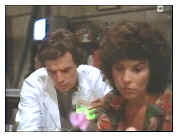 ingredients in
Swamp Thing with Ray
Wise as Alec Holland, Adrian Barbeau as Alice Cable and Louis Jourdan as Arcane. Arcane is a mad scientist who
wears for a disguise a blonde wig attached to the rubber mask of a dead man. I looked for
links to Fuhrman in Swamp Thing before I heard of Murder in Greenwich mostly
because Louis Jourdan is a French actor and Adrian Barbeau is a French name. I was looking
for anything French. I was also looking for purple flowers or flowers with the same colors
as the larkspur in the Mothers poem photo and the real larkspur on the ground
in front of it. A rain forest seemed like a good place to poke around. I found them all. ingredients in
Swamp Thing with Ray
Wise as Alec Holland, Adrian Barbeau as Alice Cable and Louis Jourdan as Arcane. Arcane is a mad scientist who
wears for a disguise a blonde wig attached to the rubber mask of a dead man. I looked for
links to Fuhrman in Swamp Thing before I heard of Murder in Greenwich mostly
because Louis Jourdan is a French actor and Adrian Barbeau is a French name. I was looking
for anything French. I was also looking for purple flowers or flowers with the same colors
as the larkspur in the Mothers poem photo and the real larkspur on the ground
in front of it. A rain forest seemed like a good place to poke around. I found them all.
Ray Wise
is Leland Palmer in Twin Peaks and Fire Walk With Me. He is a killer cop in
an episode of Moonlighting and a soap opera star in Cat People. He is Leon
Nash in Robocop, one of the Old Detroit gang members that Robocop sees in his
flashback of being shot to death when he was Alex Murphy. Alex Murphy sees all of the gang
members who fired him up when he runs a list of Emils known associates
on the police station computer. Detroit is a French name and a blanked out French
connection to the Greenwich police in Murder in Greenwich.
Fuhrman
and Weeks arrive at the Greenwich police station in a Pontiac sedan. Madonna grew up in
Pontiac Michigan, often called a suburb of Detroit, probably because the Detroit Lions
once played football there. Windsor Ontario is closer to Detroit than Pontiac or Auburn
Hills where the Detroit Pistons play basketball. In Madonnas 1991 Truth or
Dare documentary of her Blonde Ambition tour she refers to her Palace of
Auburn Hills concert as a trip home to Detroit. Mimicking Dorothy in The
Wizard of Oz she says, Theres no place like home. Theres no place
like home. Alec Kesheshian is her director. Berry Alexander Brown is her Editor. Jim
Clawson and Jay Rowe are listed as producers.
Remember Elviras
references to her head, The Haunted Palace and Elvis? Elvira is
Elvis with the s deleted and ra in its place. Madonnas
birthday is the anniversary of Elvis Presleys death. The movie scene where Fuhrman
tells Weeks about the value of x is where he makes his Elvis joke in the book. Madonna has
a brother named Christopher and a daughter named Leon. In 2000 she won a lawsuit against a company
using her name to promote an X-rated website. When her Truth or Dare director tells
her how he wants to see her perform with the bottle she calls him a motherfucker
and does it her way. This bit tells you who the real writer, director is and producer is.
Irwin
Allen was a writer for the TV series Lost in Space with Angela Cartwright. He
produced The Towering Inferno (74) with O.J. Simpson and The Poseidon
Adventure (72) with Leslie Nielsen, Stella Stevens, Roddy McDowall, Gene
Hackman and Pamela Sue Martin. The Lady in Red (79) stars Pamela Sue Martin
as the woman whos red dress points the finger of death at John Dillinger. Robert
Forster is a hitman.
In the
first Smoking Gun, I drew my clues to the Bundy killers identity through the
baseline assumption that the killers primary motive was to draw attention to
himself. Thats how political assassins did it but they usually ended up the way Adam
Grant did in Shadow Play. Melvin Purvis did it by using The Lady in Red
to kill a Public Enemy.
The idea
of getting good publicity by killing people is not new. You see it every time a prosecutor
seeking the death penalty wins the case, a judge sentences a criminal to die, a governor
signs the death warrant and a prison warden carries out the sentence. When cops
plant evidence to start this process or shoot a suspect to death in the line of duty
you get the same result as long as the person they do it to looks despicable. The
trick, therefore, is to assassinate the image of the accused first. You can collect
all the incriminating evidence you need in advance. You can establish motive, means and
opportunity. You can then kill anyone you choose as long as the evidence matches the image
of the accused.
If you
have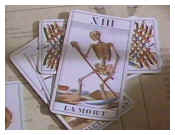 skeletons in your closet you can come off in the media as a victim of unfair
or irrelevant allegations if you lie well enough in court. You cant find better
guidelines for playing the death card this way than in movies. You can go a long way with
your composite character just by using the right combination of characters from Swamp
Thing, Fear, The Face of Fear, Murderous Vision, Ricochet,
Body of Evidence and When Dreams True.
By the way, the value of x in When Dreams Come True is in the Tarot card deck. Its XIII, the death
card. skeletons in your closet you can come off in the media as a victim of unfair
or irrelevant allegations if you lie well enough in court. You cant find better
guidelines for playing the death card this way than in movies. You can go a long way with
your composite character just by using the right combination of characters from Swamp
Thing, Fear, The Face of Fear, Murderous Vision, Ricochet,
Body of Evidence and When Dreams True.
By the way, the value of x in When Dreams Come True is in the Tarot card deck. Its XIII, the death
card.
Contact the author:
Jasper Garrison
Send comments/suggestions
[email protected]
Copyright © 2004
Smartfellows Press
|

