|
|
Chapter 32Time Talks
<![if !vml]> <![if !vml]>
The hardest part of making up a story
with no basis in fact is getting time and space to go along with it
. As the
opening credits of The Spider and the Fly roll you see rain beating down heavily on
a city street as it does in the opening of The Resurrected and Body of Evidence.
A black Lincoln Continental pulls to a stop. You hear the role of thunder as you see a
close-up of a New York City license plate. In the opening credits of Bird on a Wire,
you hear The Fifth Dimension singing The Age of Aquarius, and the sound
of rolling thunder in the retracting mechanism of a prison gate. You see a close-up of a
New York license plate. As the camera pans up you see beads of water from a recent rain on
the body and windshield of a black Corvette. The
Spider and the Fly camera moves up past the distinctive Continental grille. The rain
on the glass distorts the image of the man inside. Somehow you know he is going to light a
cigarette as the Maryland Man does with rain beating down on his black Mercedes in Murder
in Greenwich and earlier with water on his windshield from a recent rain. Like the
Maryland Man, the New York man lights a cigarette. You see
the Blood on a
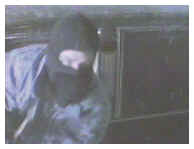
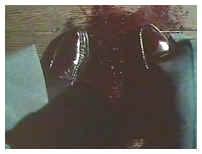
killers dark leather gloves is hard to see. You know its there only by the
blood that it contacts during or after the murder. If a film director wants to make a
dramatic point of connecting bloody gloves to a killer he uses tan leather, white linen or
white latex because the red stain shows up better on camera. Dark leather has a natural
sheen and hides the color. Blood on dark leather only makes it shinier. So does water. If you
followed After the
preview showing of The Spider and the Fly a friend of Michaels asks him what he
thought. Michael tells him that he didnt have to think. When you see the man in the
Lincoln smoking a cigarette as he looks up at the house, you know that he is waiting for a
signal. When the light comes on in the bathroom and you see the womans silhouette,
you know that is the signal. You know that the Lincoln man and the woman in the
shower are partners in crime. You know that he is going to kill the man in bed and she is
going to kill him. You know that you are looking at a combination of Double Indemnity,
and Body Heat. Thats
why Michael didnt have to think. Whether or not he read Diannas book he knew
what was going to happen because he knew the source material, he know the writers
M/O and he had time to put everything in the right order. He didnt have to think
because everything falls into place automatically. He sees that Dianna has bypassed the
intellect of her audience by serving up goodies to appease their basest appetites. They
want firm breast; she gives them firm breasts. They want a man they despise to die; she
kills him. They want a heroine with the guts to do what they wished they could do; she
gives them that heroine. Her movie is what this movie should be, an erotic thriller. When
Michaels housekeeper tells him that a police detective wants to talk to him, he
doesnt question the mans credentials, as he probably would have if he had
opened the door. His housekeeper told him he was a police detective, he looks like one and
he behaves like one. The man gives him shocking news about the murder of a man he wanted
to kill and asks questions that put him on the defensive. Everything happens so quickly
that he doesnt have time to think anything through. He even accepts the absurd idea
that the window in his study must have come open when the only way it could
have opened is if someone lifted it. The idea
that Dianna might be play-acting her perfect murder scenario with the cooperation of
someone Michael knows and someone he doesnt know, never seeps into his thought.
Hes too busy ducking the flurry of emotional punches coming at him from left and
right to see anything but the evidence piling up in front of him. He knows that
Dianna has framed him for a murder she committed but she seems to have thought of
everything including the tiny hole in the bloody latex glove that would account for the
speck of blood on the clock hand. He handled the gun and got the cut before he
proposed the game. Consequentially, everything he sees and hears checks out as real
until the detective pushes him to the door reading him his rights and he sees
Erwin Stroud grinning at him on the other side. Erwin
opens the door. In come Helen and Blair smiling at the success of the practical joke.
Dianna introduces Michael to the detective, who is really her brother Evan.
The arrest becomes a party. Michael takes his defeat in good humor and
everyone appears to be in a good mood when its time to leave everyone, that
is, except Diannas brother Evan. Dianna
stays Later that
night when the rain has stopped and Michael is in his bathrobe, Dianna kisses him
goodnight, explaining that she has to get up early. Yes, Dianna did You see
the actual murder from the killers perspective after Dianna leaves Michael. Erwin is
alone in his office. An unexpected visitor startles him but he recovers when he sees who
it is. He jokes, Are you trying to kill me? The visitor shoots him twice in
the chest. The impact of the bullets slams Erwin against the window. He slides to the
floor leaving a big blood smear on the glass. You get a
glimpse of a mans shoes and trousers as the killer nearly touches the silencer on
the barrel of the gun to Erwins spine and pulls the trigger. The scene ends with the
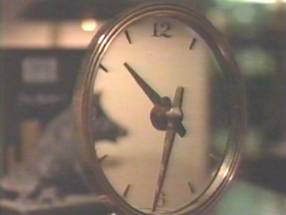
killers hand in a latex glove pulling the plug on Erwins clock, stopping it at
10:31, the actual time of the murder. By creating the illusion that the killer tampered
with the time, the killer buries the truth in a lie producing the same effect. You
cant trust anything you see. A woman might have worn the shoes and trousers or used
a man as her murder weapon. You have evidence pointing to everyone who played the game.
The nine-millimeter bullets in the body came from Diannas gun but she reported the
gun stolen before the murder. Anyone who knew about the game could have stolen it. In the
scene following the murder Kim Coats as Det. John Deluca is kneeling beside Erwins
body taking notes. Its daylight. You see a long blood smear where it looks like
Erwin dragged himself and pulled the plug on the clock before he expired. A queasy young
photographer is taking photos and trying to hold his lunch while Deluca tells him a story
about his first homicide. He goes into graphic details about slipping in the victims
blood, rolling around in the gore and later reaching in his pocket for his key and pulling
out this stuff
. Frankie Faison
as Det. Turner walks Let's pause
here to review The Spider and the Fly parallels to the Bundy murders, combining the
movie within a movie evidence and the hoax evidence with the real evidence on
Bundy and Rockingham
The Spider
and The Fly movie within a movie gives us an open door, a Lincoln (Abe Lincoln
on a penny), a double homicide, a knife, a killers shoeprints, a leather glove and a
ski mask near a male victims feet. The hoax gives us a celebrity suspect, a
speck of blood, blood matching the suspect; blood on a turn dial,
a nine-millimeter pistol, a stopped clock and a bloody glove. The real murder
gives us a Catholic, a Jew, a black man, a man who steps in blood on a grisly murder scene
reaching into his pocket for keys and pulling out a murdered mans gore (Lincoln),
and the Fire Department. The front
door of Nicole Simpsons condo was open. Her Swiss Army watch had a large face with a
minute and an hour hand. Something or someone stopped it at 10:03. Ron Goldman was Jewish.
Nicole was Catholic. A Fire Department EMS worker pronounced Ron and Nicole dead. The
killer stepped in the victims blood leaving shoeprints in Det. Fuhrmans size
and drops of blood on the scene later identified as O.J.s. Fuhrman found a bloody fingerprint on a turn
knob, a spec of blood on O.J.s Bronco, a small piece of plastic
near a bloody glove and a ski mask. He noted possible gunshot wounds and he
explained the coins on the ground (a dime and penny) that he had a photographer take a
picture of as falling from the killers pocket when he reached for his keys. The full
photo of Det. Fuhrman pointing to the bloody glove on Bundy shows the gun in his holster.
Like Dianna Taylors, its a nine-millimeter pistol. While he is on the murder
scene looking at Ron Goldmans body he says in Murder in Brentwood that he
joked with his lieutenant. The Spider and the Fly doesnt give Sifting
through the evidence of O.J. Simpsons guilt, you get a lot of it from Nicole in the
89 incident with the photos of her face, her collar, her arm and her version of what
happened. Despite the prosecutions claim that Nicole called 911, evidence that
O.J.s housekeeper Michelle made the call is much stronger. The evidence is stronger
that Nicole attacked Michelle, Michelle screamed, slapped Nicole and Nicole hung up the
phone. The evidence says Michelle, rather than O.J. fought with Nicole, slapping,
punching, scratching and pulling her hair. No one bothered to get Michelles story or
check for cuts and bruises on her body. No one bothered to see if the mud stain from a
recent rain on the side of Nicoles white pants matched the ground outside of
Michelles bungalow door. The bruise
on Nicoles forehead and collar squares with O.J.s account of wrestling her out
of their bedroom. The bruise on her arm squares with the responding officers account
of Michelle trying to pull her out of the squad car. The 89 911 call has a long open
line with no one saying anything until you hear a womans scream, a slap and a grunt.
There is no male voice on the tape and no identification of the caller. When the
police arrived Nicole was hiding in the bushes wearing only a bra and pants. She stayed
hidden until the senior officer announced that he wasnt going to leave until he saw
the woman who was beaten. Looking at everything, including Nicoles delay
in running to the police officer sobbing and claiming that O.J. was going to shoot her,
you get a hoax. You get a story improvised to fit what Nicole now knew the cops expected
to see when they got the call. She gave only the responding officers the impression the
she was afraid for her life. When the police
were gone she gave Al Cowlings the impression she was angry. Mark
Fuhrman is a very smart guy. I have no doubt that he figured out what happened and decided
to use it in a plan to put himself in the international spotlight. My epiphany
came when I tried to test this idea on other people and discovered that I couldnt
even get people to think about it. They didnt have to think. They saw and
heard enough to convince them that O.J. beat his wife and lied about it. The End. All of the
evidence against O.J. Simpson fits the same pattern. You see it in Michael Moores
response to the news that Irwin was murdered, an emotional response that robbed him of his
ability to make rational distinctions between reality and fiction. Michael sees a NYPD detective without a partner. Okay. A window slides
up. Okay. A cop car that he doesnt see is outside. When Michael sees the evidence
against him he knows that Dianna killed Erwin before he knows that Erwin is
dead. When Deluca
and Turner appear If the
evidence against Michael had implicated someone else he would have believed it because he
believed that no one would attempt to pull off a frame like that in real life. It would be
too obvious. Thats why it would work. Nobody would entertain the possibility that it
was staged long enough to work through the evidence. All rational thought stops at the
instant of conviction. From there on the goal becomes to prove the conviction or to defend
it, to reorder the evidence until it fits and to dismiss evidence that doesnt. The
evidence against O.J. did just that. What
Dianna did to Michael in the game was easy. She just used the elements available to her to
fill in details of a plan she already made. She used real incidents and movie clichés
that nobody takes seriously. These movie clichés work in reality because of established
psychological principles. But to make them work you have to reconfigure time as Fuhrman
did in Murder in Greenwich to break Michael Skakels alibi. Thats how
Dianna was able to destroy Michael Moores alibi. Thats how Mark Fuhrman gave
himself two alibis for the Bundy murders. Fuhrman
said he left the police union seminar, about 150 miles from the murder scene around 8:00,
just before the barbeque started. He said that he stopped to get gas and a soft drink
about an hours drive from his home. Nobody saw him but he said he paid with a credit
card. This was his second alibi for the flexible timeline he argued in Murder
in Brentwood that Marcia Clark should have used because, among other things,
peoples watches or clocks are set
differently. His time range, as opposed to timeline, is 10:00 to 10:45. In The Spider and the Fly, Colm
Feore If you
need a credit card or a soft drink in the hands of that detective, you get
something very close to both within the following two minutes. The camera
swings The
credit card comes in the form of a wager a promise to pay a debt and
the authority to collect it when the bill comes due. Deluca bets five dollars that Blair
did it. Kimuras money is on Dianna. Kimura represents the credit card holder and the
credit card company because he gets something for his money a soft drink and more
money. Kimura
figures that Dianna is going to take the money she makes from the murder and skip to
Barbados. Turner doesnt see it that way. He says, Whoever did it knew they
would be under the spotlight
They enjoyed it. He got the right profile, the
profile of the man who murdered Ron Goldman and Nicole Simpson. But he fixed on the wrong
suspect. Perez
tells Det. Turner to interview Michael. Turner is deceptively intelligent. He doesnt
let on that he caught Michael in a lie, but you know that he did by the way his
intelligence works against him as he begins to lean toward Michael as his prime suspect. Remember
the Murder in Greenwich scene where Stephen Weeks calls Fuhrman a gumshoe? You see
a close-up of the car wheel. You hear Fuhrman and Weeks talking about Marthas
murder. You see Fuhrman fold a copy of the Greenwich Bulletin newspaper with his
photo next to a photo of O.J. wearing the leather gloves over latex gloves. You see the
headline, Disgraced Cop to Write Book on Moxley Murder. Fuhrmans
disgrace, of course, was his lie on the witness stand. The Spider and the Fly gives
you the following in 34 seconds: Michael lies to Turner. Turner chews gum. You see a
close-up of a car wheel. Then you see shoes. You see Dianna wearing leather gloves, a man
wearing dark gloves and looking at a newspaper, two cops talking and an angry woman
snatching a bulletin off a telephone pole. Here, I
must confess So as not
to leave you hanging with The Spider and the Fly, Ill fill you in on some
things you might be wondering about
. Erwin
Strouds hold on Dianna was her identity. She tells Michael she is from Washington
State and a cut on her back is from a car accident. She is really Lisa Ann Samples from
Oregon. She was convicted of murdering her husband Jimmy in a domestic
argument but received a suspended sentence because wounds on her face and body
indicated that her husband cut and beat her. The audience knows that her husband
didnt beat her. Her jealous brother did. You see him in her upstairs window slapping
her face, tossing her on a couch and jumping on her. Evan might have pulled the trigger
but in the end, she showed that she could have used him as her weapon or done it herself
and enjoyed it. The
Spider and the Flys only weakness is the censorship imposed on any movie
produced for commercial TV. There are no nude scenes when they are called for to give a
visceral impression of the sexual chemistry between characters who are supposed to be
driven by sexual obsession. The movie has the writer of steamy erotic thrillers like Body
Heat, Jagged Edge and Basic Instinct shout in anger, Youre
sleeping with her! It has adults about to do the nasty talking like teenagers being
closely observed by Southern Baptist church ladies. Its a 90-minute movie with a
2-hour scope truncated to make room for commercials. Time talks
because time, place and action are inseparable. If the action doesnt fit the time
and place it cant be real. It cant even be realistic.
Where and when Michael finds computer disks the killer stole to frame
him for Blair’s murder tells him who the killer has to be. In fact or
fiction time has to agree with action. An alibi is only an alibi if the
suspect doesn’t have time to be where the crime happened when it
happened. If you animate the various stories of Allan Park spotting Kato
and O.J., you get two stories that agree with phone record time stamps,
Kato’s and O.J.’s. Any variation of Marcia Clark’s story, Allan Park’s
or Fuhrman’s give you O.J. and Kato seeing each other or passing through
each other like phantoms. Time and space give O.J. an alibi. They give
Fuhrman the opportunity to commit the murders on Bundy and to frame O.J. on Bundy and Rockingham. The means come
from film and television. Compare Mark Fuhrman’s Michael:
Your heroine is a serial killer with no redeeming qualities except firm breasts
you
choose to explore the baser sensibilities of human nature with no sense of justice or
moral perspective. Dianna:
Dont tell me you are one of those zealots who believe film and television give
people grisly ideas. Michael: I
live in New York. Translation: Michael has seen it happen So have you.
Contact the author:
Jasper Garrison Copyright © 2004 Smartfellows Press
|
 <![endif]>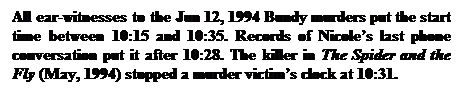
 behind with
Michael.
behind with
Michael.